
Legacy Procurement Frameworks Are Blocking Agentic AI from Scaling
 Tomas Kauer - News Moderator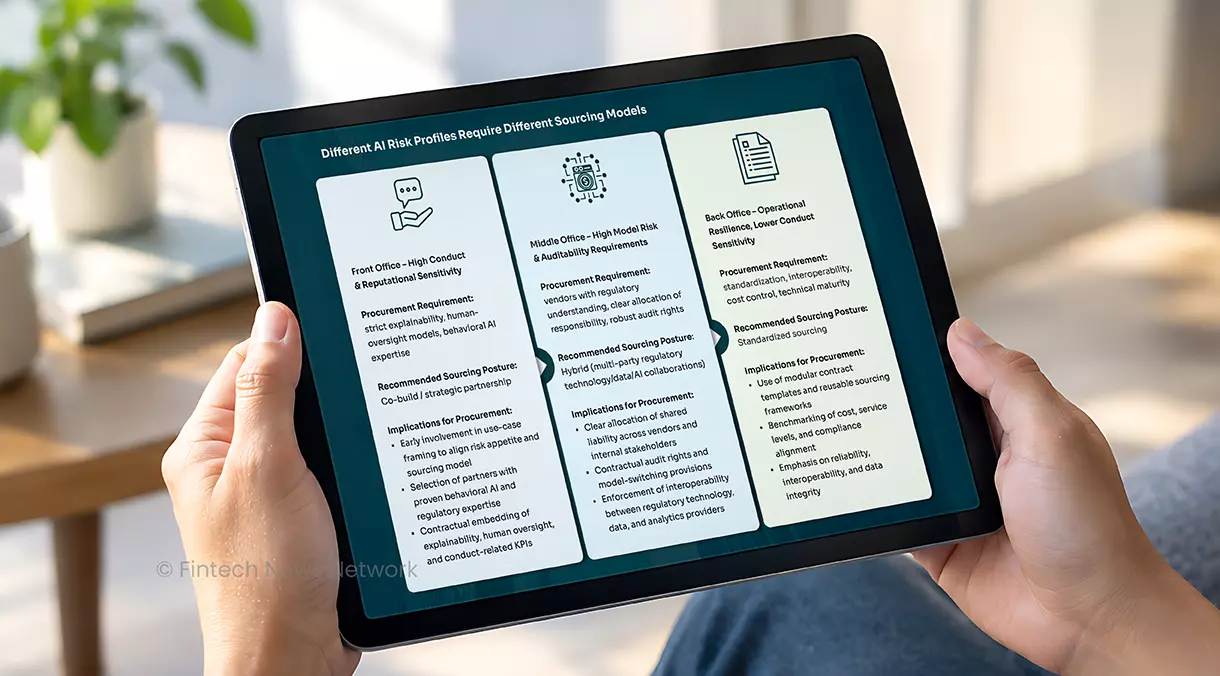
In the financial services industry, agentic artificial intelligence (AI) promises significant benefits across functions and use cases, including front-office personalization, fraud investigation, and back-office processing.
Yet, several obstacles limit the adoption of AI agents across organizations, keeping most deployments at the proof-of-concept (POC) stage, according to a new report by Inverto, a consultancy specializing in strategic procurement and supply chain management, and a brand of Boston Consulting Group (BCG).
These issues mostly arise because procurement and governance frameworks are designed for stable, deterministic software. These frameworks cannot accommodate systems that evolve continuously, distribute accountability across vendor layers, and require a level of auditability that standard contracts do not support, oftentimes preventing agentic AI initiatives from scaling.
To address these challenges, the Inverto paper examines key hurdles when deploying agentic AI in Europe and outlines recommendations for procurement, technology, risk, and compliance leaders. These steps are designed to help these professionals design sourcing models, contract structures, and governance mechanisms that will allow agentic AI to shift from supervised pilots into supervised production.
Most common mistakes and challenges to agentic AI implementation
The first challenge outlined in the Inverto report is that traditional procurement relies on stability, with fixed requirements, predetermined milestones, and predictable outputs. While these assumptions hold for classical IT projects, they fail in the context of agentic AI, causing pilot projects to remain trapped at the PoC stage, budgets to run out before scaling, and governance reviews to fall behind the technology they should monitor.
Another issue is that agentic AI comprises a range of capabilities used in varied contexts with distinct risk profiles. For example, a customer-facing advisory agent or an anti-money laundering (AML) triage assistant does not carry the same regulatory exposure, accountability demands, or failure modes as a back-office reporting orchestrator.
Yet, most financial institutions apply identical procurement templates and governance workflows to all AI agents. This leads to misapplied safeguards.
A further challenge is that agentic AI can generate recommendations, trigger actions, or shape decisions. This shifts how responsibility is distributed across systems and organizations.
Inverto notes that three areas need clear accountability: who is responsible when an agent’s autonomous output causes harm, who maintains auditability over decisions from a continuously evolving system, and who ensures compliance when multiple vendors contribute components to the same workflow.
Finally, the last major issue highlighted is that agentic AI needs continuous improvement. This is a challenge because most commercial arrangements are designed for one-off delivery, with fixed scopes, fixed budgets limit, IP restrictions, and terms that rarely reward post-launch improvement. This often results in agentic systems stagnating before they reach the maturity that justifies the investment.
Procurement: an architect of AI deployment
In Europe, Inverto notes that scaling agentic AI in financial services requires navigating a complex regulatory landscape. The environment includes the EU AI Act, the Digital Operational Resilience Act (DORA), circulars by Germany’s Federal Financial Supervisory Authority (BaFin), and the European Central Bank (EBC) expectations.
These constraints reshape procurement, requiring coordination among sourcing models, governance mechanisms, contractual controls, and supplier relationships so that innovation advances with full regulatory alignment without creating a compliance bottleneck.
To achieve this, the report highlights five key pillars. First, procurement should adopt a targeted sourcing strategy. This strategy should align with business impact and risk based on the specific applications and use cases selected beforehand.

Second, financial institutions cannot rely on traditional linear procurement processes for technologies that evolve continuously like agentic AI. At the same time, uncontrolled experimentation is incompatible with supervisory expectations.
Adaptive procurement addresses this issue by reframing PoCs as the first governed step in a structured scaling model. When embedded in a phased approach with clear decision gates, accountability, and outcome criteria, PoCs become a controlled mechanism for learning and a deliberate gateway to industrialization, Inverto says.

Another key recommendation involves clearly translating regulatory expectations into contractual structures before negotiations begin.
In an AI-driven landscape, contracts function as both commercial instruments and governance mechanisms. Supervisory bodies expect financial institutions to demonstrate who is responsible for system outputs, how decisions can be traced, and how systems are monitored over time.
Hence, procurement should define enforceable stances on data usage, audit rights, and responsibility before entering negotiations.
Another recommendation from Inverto involves turning innovation into a repeatable capability. Supervisors increasingly expect evidence of control, leading institutions relying on bespoke processes for each use case to risk inconsistency, delays, and regulatory exposure.
Procurement can solve this by developing a standardized AI procurement control framework that provides a reusable and auditable system of templates, tools, and governance artifacts. Standardization codifies good practice, accelerates adoption, and ensures that innovation is consistently implemented within a mature control environment.
Finally, the last recommendation is to build an agentic AI supplier ecosystem. Most financial institutions already work with a mix of large technology providers and specialized niche vendors. In most cases, these relationships are managed independently by different functions, governed through inconsistent contracts, and optimized for individual use cases rather than system-wide accountability.
Agentic AI changes this dynamic. Because autonomous systems increasingly span multiple vendors, models, and decision layers, the supplier landscape itself becomes a source of risk if it is not deliberately structured.
In this context, the role of procurement is shifting from managing individual vendor relationships to actively designing and governing an ecosystem. They must ensure that stability, innovation, accountability, and regulatory compliance are aligned across all contributors.
While still emerging, agentic AI represents a watershed moment for financial services, offering unprecedented opportunities for industry disruption and competitive differentiation. In wealth management, Deloitte Center for Financial Services predicts that AI, especially agentic execution, has the potential to uplift advisor productivity by roughly 30% to 100% by 2032.
At an industry level, that implies that between 25% and 50% of advisor time could be freed from lower-value operational work. In terms of assets under management (AUM), that uplift could expand industry capacity by the equivalent of US$10 trillion to US$35 trillion in additional client assets.
Featured image: Edited by Fintech News Switzerland, based on image by Sketch Graphic via Magnific
The post Legacy Procurement Frameworks Are Blocking Agentic AI from Scaling appeared first on Fintech Schweiz Digital Finance News - FintechNewsCH.